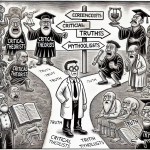


According to the article “ Ideology-Based Investigations, Myths, and Blind Spots in Academia and Society ,” despite the growing engagement of disabled and queer researchers and social actors in environmental and climate justice, their voices are rarely considered in research and action on the ecological transition. This statement, taken from a project funded by a prestigious European Union grant [1] See source , illustrates the growing paradox of contemporary research: a supposedly emancipated science, but one often rooted in ideological frameworks that compromise scientific rigor. By “ideological research,” I mean any study that deviates from the foundations of the rigorous scientific method, where hypotheses are testable and falsifiable. These studies, although often presented with a veneer of scientific rigor, are in reality based on biased philosophical or legal frameworks. On the left, they are rooted in postmodern or "critical" theories, particularly in concepts like systemic oppression and intersectionality. On the right, they draw on mythological interpretations of history, both past and present. These biased narratives from the left are termed "progressive myths" by the American philosopher Michael Huemer [2] 2 Huemer M., Progressive Myths, New York, Barnes & Noble Press, 2024. , but it seems equally necessary to acknowledge the existence of "reactionary myths" emanating from the right.
These two narratives, while distinct, share a common foundation: a simplistic binary between oppressor and oppressed (on the left) or a narrative of idealized domination (on the right). In Western academic institutions, particularly in the United States and Europe, the oppressor-oppressed model takes an extreme turn, fueled by ideological theoretical frameworks devoid of any scientific rigor. This binary model is thus promoted by higher education institutions and national and international funding bodies; it has permeated many areas of the private sector (including cultural institutions). In the United States, this model has reached a critical point, while it continues to spread and take root in Europe, including in the prestigious grants of the European Research Council (ERC). The WEIRD project mentioned at the beginning of this article is a striking example. Let's revisit what the coordinator of this ERC-funded project explains: Despite the growing engagement of disabled and queer researchers and social actors in environmental and climate justice, their voices are rarely considered in research and action on the ecological transition. Using a transdisciplinary approach, this project aims to understand and redefine the often-neglected contributions of disability and queer theory research, as well as societal initiatives around sustainability, towards new transformative theories, methodologies, and ethics for just and emancipatory sustainability. WEIRD will: (1) overcome the fragmentation of disability and queer theory research around sustainability; (2) explain how societal initiatives related to disability and queer theory contribute to just sustainability transformations by subverting ableist and cis/heteronormative social norms; (3) develop new emancipatory theories of sustainability transformations that are grounded in subversive social norms; (4) generate new transformative methodologies in sustainability science; and (5) redefine transformative justice for sustainability and the ethics of sustainability science [3] See source.
These few lines contain all the trendy and jargon-laden terms specific to critical studies and this type of research (critical disability theory, queer theory, climate justice, emancipatory sustainability, subversion of ableist and cis/heteronormative social norms, etc.). This queer/ableist ideological framework leads to self-fulfilling prophecies and confirmation bias. Queer theory, for example, does not meet the standards of a sound scientific theory. According to one accepted definition of the term, queer is “anything that is at odds with the normal, the dominant, the legitimate. There is nothing specific to which it necessarily refers. It is an identity without essence.” “Queer,” then, delineates not a positivity but a positionality in relation to the normative [4] 4 David M. Halperin, Saint Foucault, Paris, EPEL, 2000, French translation by Didier Eribon, pp. 76–77 . This concept aims to destroy the notion of normality, which is incompatible with physiology, biology, evolution, and psychology. Moreover, Joseph Henrich, a professor at Harvard University, has already made WEIRD an acronym for "Western, Educated, Industrialized, Rich, and Democratic" [5] 5 "Western, Educated, Industrialized, Rich, and Democratic" in Henrich J., The Weirdest People in the World: How the West Became Psychologically Peculiar and Particularly Prosperous, New York, Farrar, Straus and Giroux (Penguin), September 2020 (preface). This academic's work represents a remarkable scientific contribution, based on methodological rigor and solid quantitative data.
By combining anthropology, economics, and evolutionary theory, Henrich sheds light on the psychological uniqueness of Western populations. Therefore, appropriating this acronym and associating it with a project rooted in "social justice," incompatible with sound scientific research, constitutes a form of intellectual dishonesty. The funding of projects like WEIRD by an ERC grant thus testifies to the extent of the ideological influence that has infiltrated European institutions, to the detriment of the principles of rigorous scientific thought. Mythological interpretations of the past and present are rare in contemporary academia, whereas they are widespread in authoritarian societies like Russia. Authoritarian regimes justify their expansionist and repressive policies by inventing a mythological past. Putin's Russia is a striking example of this, with its notion that Ukraine and Russia have always been historically united and that Muscovy and Tsarist Russia are the heirs of Kievan Rus' [6] See source . The rigorous analyses of American historian Timothy Snyder thoroughly refute all of Putin's and his supporters' claims [7] See source . In far-right circles, the "Christian nationalist" movement [8] See source adopts a similar rhetoric, glorifying a fascist past, with theorists such as the jurist Carl Schmitt. These reactionary myths pose a real danger, having served in the past under fascist and totalitarian regimes to legitimize aggressive military expansionism and domineering aspirations. Their resurgence is deeply concerning. It is imperative to combat and vigorously denounce them, as they constitute a serious threat to the very foundations of any open society.
Furthermore, even remarkable individuals with courageous stances are not immune to ideological biases. Consider Timothy Snyder and Anne Applebaum (center-left), or Douglas Murray and Gad Saad (moderate conservative right): all champion the ideals of democracy and open society, opposing authoritarianism in all its forms. Snyder's [9] 9 Timothy Snyder, On Freedom, New York, Crown (Penguin), 2024. and Applebaum's [10] 10 Anne Applebaum, Autocracy, Inc.: The Dictators Who Want to Run the World, New York, Doubleday (Penguin), 2024. analyses of historical events, particularly what is happening in Ukraine and Russia, are highly commendable, as is their advocacy for justice and freedom. However, they remain blind to the failures of the left, the penetration of woke rhetoric, and the censorship (cancel culture) in academia and, now, in society as a whole. This inconsistency on the part of two intellectuals claiming to be heirs to the rationalist tradition of the Enlightenment, a tradition incompatible with woke demands, is striking.
Douglas Murray is a notable British writer and journalist who advocates for an open society from a more conservative perspective. [11] 11 Douglas Murray, *Taking Down the West: How Anti-Racism Became a Weapon of Mass Destruction*, Paris, L'Artilleur, 2022. Hostile to theocracies and religious fundamentalism, he is as much a fervent critic of the woke movement as he is a defender of Israel. He offers well-founded criticisms of the American Democratic Party without, however, embracing the authoritarian camp. Gad Saad [12] 12 Gad Saad, *The New Viruses of Thought: Wokism, Cancel Culture, Racialism… and Other Ideologies That Kill Common Sense*, Limoges, FYP éditions, April 2022. , for his part, is a professor at Concordia University in Montreal and now a prolific YouTuber. He shares the same political vision as Douglas Murray (vehement criticism of Wookieeism, hostility to religious fundamentalism, and support for Israel). However, some of Saad's positions seem excessive due to his alignment with the hardline Republicans and his blanket rejection of all, even reasonable, Democratic ideas. These are just a few examples of blind spots on the part of intelligent and well-intentioned individuals. Ultimately, it takes very little to overcome these blind spots: one must find the courage to assert moral clarity and resolutely oppose all ideas or ideologies that glorify lies and post-truth. This requires genuine consistency in defending the truth, in the face of attacks from all political quarters, whether they involve the invention of a mythologized past or the fantasy of a utopian future.







